

How to Lower Your Supplier MOQ Without Raising the Price
The sample is right, the price works, but the supplier wants more units than you can comfortably sell. Here is how to negotiate a smaller order by reducing the factory’s workload—not the product’s quality—and recognise when the price cannot hold.
1. Find out what is actually setting the minimum
The short answer: ask the supplier to exchange lower production complexity for a lower MOQ at the quoted unit price. Offer fewer variants, approved standard materials and packaging, or flexible production timing. Keep the specification and inspection requirements fixed; an unchanged price is a negotiation target, not a guarantee.
- Separate the total order minimum from the minimum for each SKU.
- Remove avoidable setup and purchasing costs before requesting a concession.
- Compare total costs and confirm every agreed condition in writing.
A per-order MOQ applies to the whole purchase; a per-SKU MOQ applies to each colour, size or other variant. A factory may accept fewer units overall but still require a minimum dye lot for each colour.
Ask: “Is the minimum driven by material purchasing, machine setup, packaging, or your order policy?” The answer tells you whether to change the order mix, timing or supplier—not simply repeat your request.
2. Offer five changes that protect the specification
- Freeze the non-negotiables. Attach the approved sample reference and specification: material grade, dimensions, tolerances, components, workmanship, required testing, labels and protective packaging. Say explicitly that reducing quantity does not authorise substitutions.
- Concentrate demand into fewer SKUs. Start with your strongest colours or sizes. Ask for revised total and per-SKU minimums together. Removing variants helps only if it removes real changeovers, material lots or packaging runs.
- Use standard inputs that already meet your requirements. Ask whether routinely stocked material is available in the exact approved grade and performance. Standard does not mean cheaper-grade. Verify any alternative against your requirements and approve a sample before production.
- Simplify optional packaging. If your sales channel allows it, replace custom presentation boxes with an approved standard format. Preserve product protection, mandatory markings, barcodes where needed and transport suitability. Confirm any sampling or artwork charges.
- Offer a production window, not an urgent date. Ask whether the factory can schedule your units alongside a compatible run using the same inputs. Agree a latest completion date and separate order identification. The factory must confirm compatibility and capacity.
Present these as one proposal, then ask which change actually lowers the minimum. If the supplier’s material purchase minimum remains unchanged, fewer colours alone may not solve the problem.
3. Test the deal with a hypothetical worked example
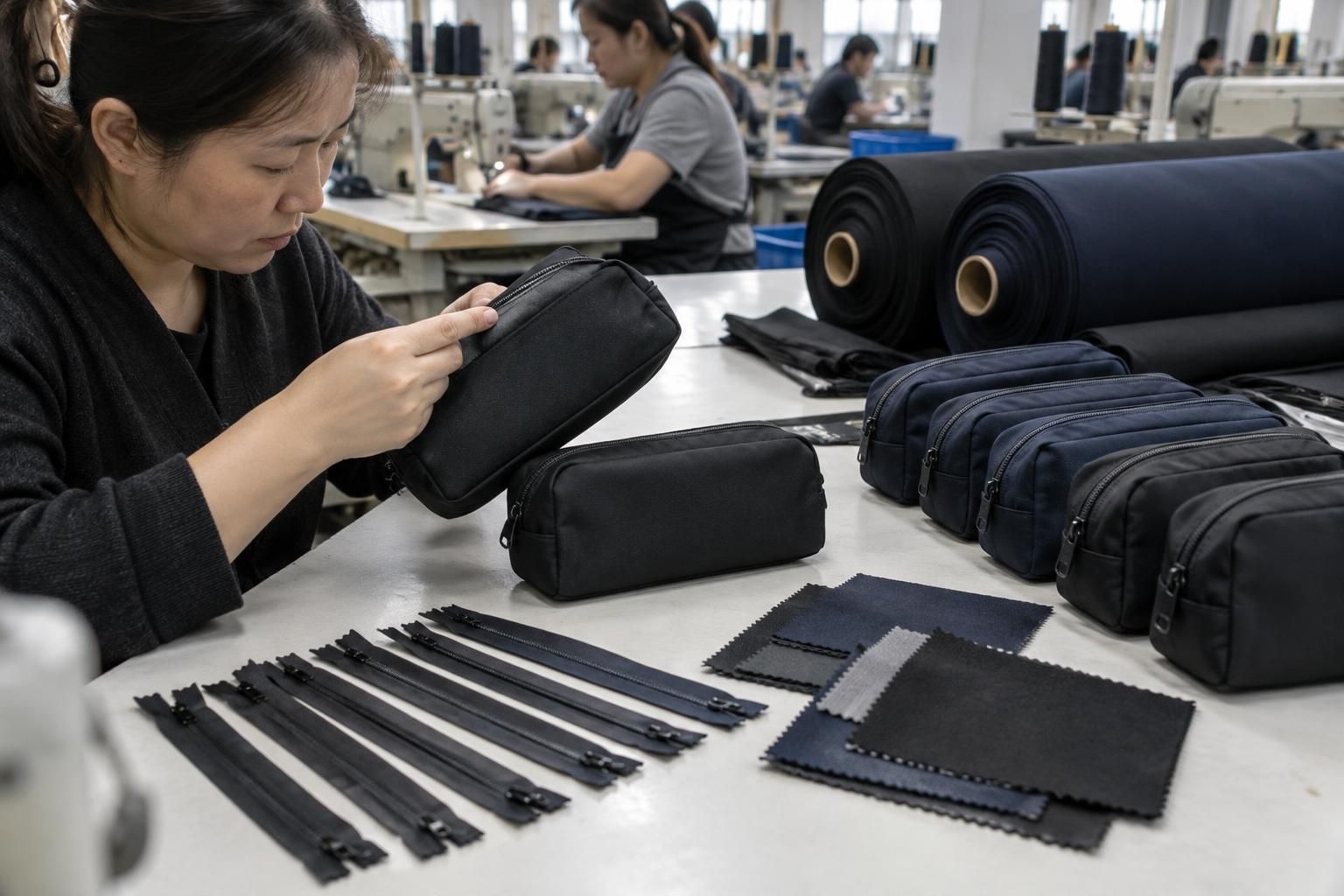
Hypothetical example—not a market benchmark or Shayyek quote: a supplier quotes 1,000 polyester tool pouches at $4 each, with four colours and a 250-unit minimum per colour. The buyer only wants 600 units.
- Original order: 1,000 × $4 = $4,000 in goods.
- Proposed order: 300 black and 300 navy pouches, both using stocked fabric that meets the approved specification.
- Unchanged: fabric grade and weight, dimensions, zipper, stitching, protective packaging, labels and inspection criteria.
- Buyer’s concession: two colours instead of four and a wider, agreed production window.
Suppose the factory confirms that avoiding two colour setups and fitting the order into a compatible run makes 600 units at $4 workable. Goods expenditure becomes $2,400—a $1,600 reduction in inventory spend, not a unit-price saving.
This result is not assured. Confirm that the $4 quote excludes no previously included items and adds no setup fee. Freight and inspection costs per unit may rise on the smaller shipment; use Taxculator to compare landed-cost scenarios rather than judging the deal by goods value alone.
4. Send a specific proposal and verify the reply
Replace the bracketed details before sending this message. Give the supplier something concrete to cost, rather than asking for its “best MOQ”.
Thank you for the quotation. Could you supply [quantity] at the quoted [unit price] if we reduce the order to [variants], use your standard materials and packaging only where they meet our attached specification, and accept production between [dates]? All quality, testing, labelling and inspection requirements remain unchanged. Please confirm the total and per-SKU MOQ, any additional fees, payment terms and latest completion date. If this is not workable, please identify the cost constraint and quote the nearest feasible quantity at that price. No substitutions without our written approval.
Supplier confirmation checklist
- Total quantity, quantities per SKU and unit price are recorded.
- Specification revision and approved sample reference are attached.
- Packaging, labels, testing and inspection scope remain explicit.
- All setup, sampling, storage and other extra charges are disclosed.
- Payment milestones, completion deadline and substitution approval are written into the order.
5. Avoid concessions that only hide the cost
- Promising future volume you cannot commit to: share an honest forecast, clearly distinguished from a purchase commitment.
- Confusing split delivery with a lower MOQ: buying 1,000 units and receiving 600 now still leaves you committed to 1,000. Check balance payments, ownership and storage charges.
- Accepting “same quality” without details: retain measurable requirements and the approved sample. A vague assurance cannot replace either.
- Dropping inspection to preserve the price: keep the agreed checks. A smaller first order is still a first order.
6. Know when to change suppliers instead
The approach may fail when dedicated tooling, custom material batches, mandatory testing or minimum line time dominates the cost. Ask for the smallest feasible batch at the original price and a transparent smaller-batch quote; compare both against your inventory risk.
If neither works, look for a factory whose existing production suits your specification. Shayyek sourcing agents can help check that fit, while inspectors can verify the agreed product requirements—not negotiate them away.
Lower complexity before asking for lower quantity, and keep quality requirements fixed. Accept the deal only when the written terms and total costs work, even if the original unit price proves unavailable.
Get sourcing support for a smaller, specification-matched order.
Ready to protect your next order?
Create your free Shayyek account and post your first inspection job.
إنشاء حساب